Head off to this link to read the opening to Genre Expectations, the first consideration when framing your story.
Enhance your Writing with Sentence Craft
Enhance Your Writing
- How do you enhance your writing?
- What is enhancing our writing?
- Why do we do it?
Here are the answers for writers who want to improve their skills.
In the forests of words that we writers grow, blazed trails mark the way to our destination. Without those trails, without paths leading down to sun-sparkled streams, without the yellow brushstroke painted on tree after tree, we might lose our direction and our sanity.
Reading through that opening paragraph, most writers will recognize the extended hiking metaphor. Many will spot inversion and alliteration. A few will appreciate the anaphora and auxesis and zeugma, even when not familiar with those terms.
This is Sentence Craft. Controlled use creates appreciative readers. Over-blown use drives readers away.
Yet you can enhance your writing with simple techniques.
- Sentence Craft—from easy imagery to involved structures—is essential for the poet.
- Bloggers and other nonfiction writers will find it a marketing tool, distinguishing them from their competition.
- Speech writers and great broadcast journalists use these devices to make their spoken words become memorable.
- With fiction, writers paint expositions and settings and character tags, capturing readers who may not even recognize the sweeping stroke of the magical wand.
Discovering Sentence Craft is for writers new and old. For newbies, word-tricks can be fascinating ventures into an unknown forest. These tricks can renew a veteran writer’s love of words and sentences flowing onto the page.
In small offerings, of course. Too many tricks glaze our readers’ eyes.
Discovering Sentence Craft covers figurative and interpretive concepts as well as the structural elements that build meaning, emphasis, and memory.
Ways to Enhance Your Writing include ~
Concepts
I: Figurative
II: Interpretive
Structures
III: Inversion
IV: Repetition
V: Opposition
VI: Sequencing
Writer M.A. Lee believes writing is a skill-based craft which can be learned and practiced. Artists learn composition, perspective, depth, proportion, and shading. A baseball player learns in-field and out-field, pitching vs. throwing, batting and bunting. An electrician learns reading blueprints, voltage and current, circuits, outlets, and panels.
A writer needs much more than grammar and spelling. Reading widely, Discovering Sentence Craft concepts and structures, and practicing them will open doors for anyone who wants to improve.
Discover more ways here:
A Writer’s Halloween?
Listen to The Write Focus podcast on Horror Stories that Writers Tell.

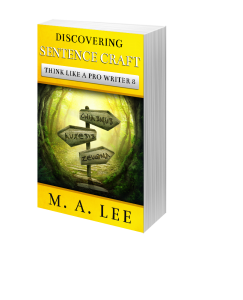
Discovering Sentence Craft
Discovering Sentence Craft is celebrating its birthday!

In the forests of words that we writers grow, blazed trails mark the way to our destination. Without those trails, without paths leading down to sun-sparkled streams, without the yellow brushstroke painted on tree after tree, we might lose our direction and our sanity.
Reading through that opening paragraph, most writers will recognize the extended hiking metaphor. Many will spot inversion and alliteration. A few will appreciate the anaphora and auxesis and zeugma, even when not familiar with those terms.
This is Sentence Craft. Controlled use creates appreciative readers. Over-blown use drives readers away.
- Sentence Craft—from easy imagery to involved structures—is essential for the poet.
- Bloggers and other nonfiction writers will find it a marketing tool, distinguishing them from their competition.
- Speech writers and great broadcast journalists use these devices to make their spoken words become memorable.
- With fiction, writers paint expositions and settings and character tags, capturing readers who may not even recognize the sweeping stroke of the magical wand.
Discovering Sentence Craft is for writers new and old. For newbies, word-tricks can be fascinating ventures into an unknown forest. These tricks can renew a veteran writer’s love of words and sentences flowing onto the page.
In small offerings, of course. Too many tricks glaze our readers’ eyes.
Discovering Sentence Craft covers figurative and interpretive concepts as well as the structural elements that build meaning, emphasis, and memory.
Concepts
I: Figurative
II: Interpretive
Structures
III: Inversion
IV: Repetition
V: Opposition
VI: Sequencing
Writer M.A. Lee believes writing is a skill-based craft which can be learned and practiced. Artists learn composition, perspective, depth, proportion, and shading. A baseball player learns in-field and out-field, pitching vs. throwing, batting and bunting. An electrician learns reading blueprints, voltage and current, circuits, outlets, and panels.
A writer needs much more than grammar and spelling. Reading widely, Discovering Sentence Craft concepts and structures, and practicing them will open doors for anyone who wants to improve.
Plot ~ All Writers Need to Know
From September to December, The Write Focus podcast will focus on Plot.
Everything to do with Plot.
Freytag’s Pyramid and the Beats.
Plot Points and Pinch Points and the Complex Plot Structure.
Three-Act … or Four-Act Structure.
Shakespeare’s Structure.
And the best Structure of All, the most adaptable to every writer’s needs, able to be stripped down to the basics or built into cycles for epic length.
We cover it all, every Wednesday as the year cools into autumn and winter.

Information comes from our host M.A. Lee’s guidebook Discovering Your Plot,
with assistance from Edie Roones and Remi Black.
What do writers want from plot?
What do writers need from plot?
As wordsmiths, we writers know that want and need are two different words.
- The want is a circumstance that we writers can control. We want plot specifics to help us craft story and exceed reader expectations.
- The need is a circumstance of obligations from reader expectations of story. While readers may want the comfort of the genre elements (the tropes), they also wish to have their interest and curiosity piqued.
Can we writers deliver on the expectations and the surprises in order to please our readers?
That’s the involved question that our series based on Discovering Your Plot hopes to answer.
Join us.
How to Find Us
Listen on your favorite podcast site: from Apple to YouTube, Spotify and Podbean (my favs), Google Play, Amazon Music / Audible, Samsung and Player FM, Podcaster, the rivals iHeart and Tune-in, and too many to list.
Here are links to the easiest podcast services. Find our green logo and follow.
My favorite podcast is Podbean. https://eden5695.podbean.com/
YouTube direct link to the last playlist on Branding: https://www.youtube.com/playlist?list=PLXi3M_aM-d7L4OtDk2Bde7LDwQ2l7K8NE
Apple https://podcasts.apple.com/us/podcast/the-write-focus/id1546738740%20
Spotify https://open.spotify.com/show/4fMwknmfJhkJxQvaaLQ3Gm?si=ffeb71ed17c3409d
Amazon/Audible https://music.amazon.com/podcasts/062ecc60-d61c-432a-ad99-8234c1044ef1
ListenNotes https://lnns.co/y_Jg5rpaMNo
Google https://podcasts.google.com/feed/aHR0cHM6Ly9mZWVkLnBvZGJlYW4uY29tL2VkZW41Njk1L2ZlZWQueG1s
Tune-in https://tunein.com/podcasts/p1608565/

The Write Focus presents information on productivity, process, craft, and tools. Our podcast is for newbies who want to become writing pros and veterans who are returning to writing after years away.
For up-to-date links and resources, visit www.thewritefocus.blogspot.com .
Wish I’d Known ~ About Podcasting and Writing

We don’t often take the time to look back, to do a retrospection, a look at What I’d Wish I’d Known before ever starting. We track our accomplishments. Then we diligently write down the small steps that take us to our short-term goals and on to our long-term ones.
If we’re good little bunnies, we check our Master Plan once a year. We should rewrite it every third or fifth or seventh year. I can’t imagine a 10-year Master Plan. After my first five-year plan, I had to drop back from five to three because my plans change so much. I get new information. I clarify my goals I shove things forward that I wasn’t able to accomplish when I first envisioned them through rosy-colored glasses.
Even so—when we do stop and look back, we should consider all we’ve gained, all we’ve learned, and share that with others. Advice along the lines of “Wish I’d Known”.
We have a two-episode Retrospective, first on Podcasting, especially since many people are exploring podcasting as a new endeavor, on May 15. Then on May 22, the Retrospective focuses on Writing.
Decisions. Regrets. We cover them all.
Link to the audio of the May 15 episode: https://eden5695.podbean.com/e/520-wish-id-known-a-podcasting-retrospective/?token=002359eb986dd8adc7af0ec72855c8d2

Writing Challenge Rewind ~ All through June
On The Write Focus, we’re posting a daily podcast from Write a Book in a Month, by Remi Black.
Daily check-ins include the project stage progressing word count as well as speculations on writing in general and the writing business in particular.
Click this link to visit TheWriteFocus blog.
Criteria for the Challenge ::
1] Daily Word Count
2] Length to Goal
3] Reason for the Goal
Each episode runs less than 10 minutes. Listen briefly every day or hoard up several episodes for when you fix a quick dinner, drive a short commute, or take a brisk walk.
Lessons for writing happen along the way!
Each episode will conclude with the two quotations from professional writers (Hemingway! Heinlein! Atwood! More!!!) that opened and closed the day’s writing sessions.
Episodes ::
- 1 :: No Fooling
- 2 :: Change of Plans
- 3 :: Stick with the Plan
- 4 :: Nix Distractions
- 5 :: Watch for Warnings
- 6 :: Life Rolls
- 7 :: Win-Lose-Wind
- 8 :: Critical vs. Creative
- 9 :: Eat the Frog First
- 10 :: The Tax Man Cometh
- 11 :: Cocoons
- 12 :: Six Words Short
- 13 :: Wonders Never Cease
- 14 :: One Project, Two Project
- 15 :: Promotions
- 16 :: Covers
- 17 :: Frittery Jittery
- 18 :: Flipping Out
- 19 :: Input / Output
- 20 :: Looking Ahead
- 21 :: Short Post
- 22 :: Biz Monday
- 23 :: Master Book
- 24 :: Expect the Unexpected
- 25 :: Carpe Diem as Writers
- 26 :: Nose to the Grindstone
- 27 :: Writers’ Groups
- 28 :: First Celebration
- 29 :: Writers Conferences
- 30 :: An End that’s Not an End and Lessons List
- July 5th :: Aprés-Draft Update
Listen on the following sites.
Bookmark your favorite to come back daily.
Podbean: The Write Focus (podbean.com)
Apple podcast https://podcasts.apple.com/us/podcast/the-write-focus/id1546738740%20
Spotify https://open.spotify.com/show/4fMwknmfJhkJxQvaaLQ3Gm?si=0GFku2PbShWXiDhRp7JaDQ
YouTube Channel Writers Ink Books – YouTube
Join us!
Resources as of April 20
Amazon links are given because it’s easy, and for no other reason.
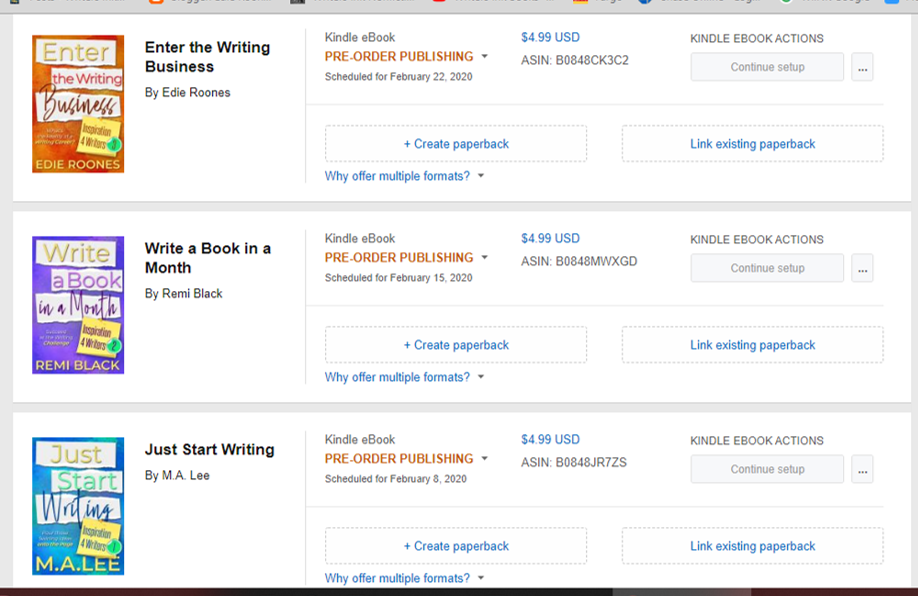
Purchase Write a Book in a Month at Amazon here. https://www.amazon.com/dp/B0848MWXGD
Also mentioned in the first 10 episodes (March 31 to April 5) ~
Patty Jansen’s Self Publishing Unboxed Amazon.com: Self-publishing Unboxed (The Three–year, No-bestseller Plan For Making a Sustainable Living From Your Fiction Book 1) eBook: Jansen, Patty: Kindle Store
Purchase Think/Pro at Amazon here: https://www.amazon.com/Think-like-Pro-Advent-Writers/dp/1983248266/
The Think/Pro planner for writers can be purchased here: https://www.amazon.com/Think-Pro-Planner-M-Lee/dp/1983248673/
Dwight V. Swain’s Techniques of the Selling Writer https://www.amazon.com/Techniques-Selling-Writer-Dwight-Swain/dp/0806111917/
Anne Morrow Lindbergh Gifts from the Sea https://www.amazon.com/Gift-50th-Anniversary-Anne-Morrow-Lindbergh/dp/0679732411/
Marie Kondo The Life-Changing Magic of Tidying Up https://www.amazon.com/Life-Changing-Magic-Tidying-Decluttering-Organizing/dp/B00RC3ZGN4/